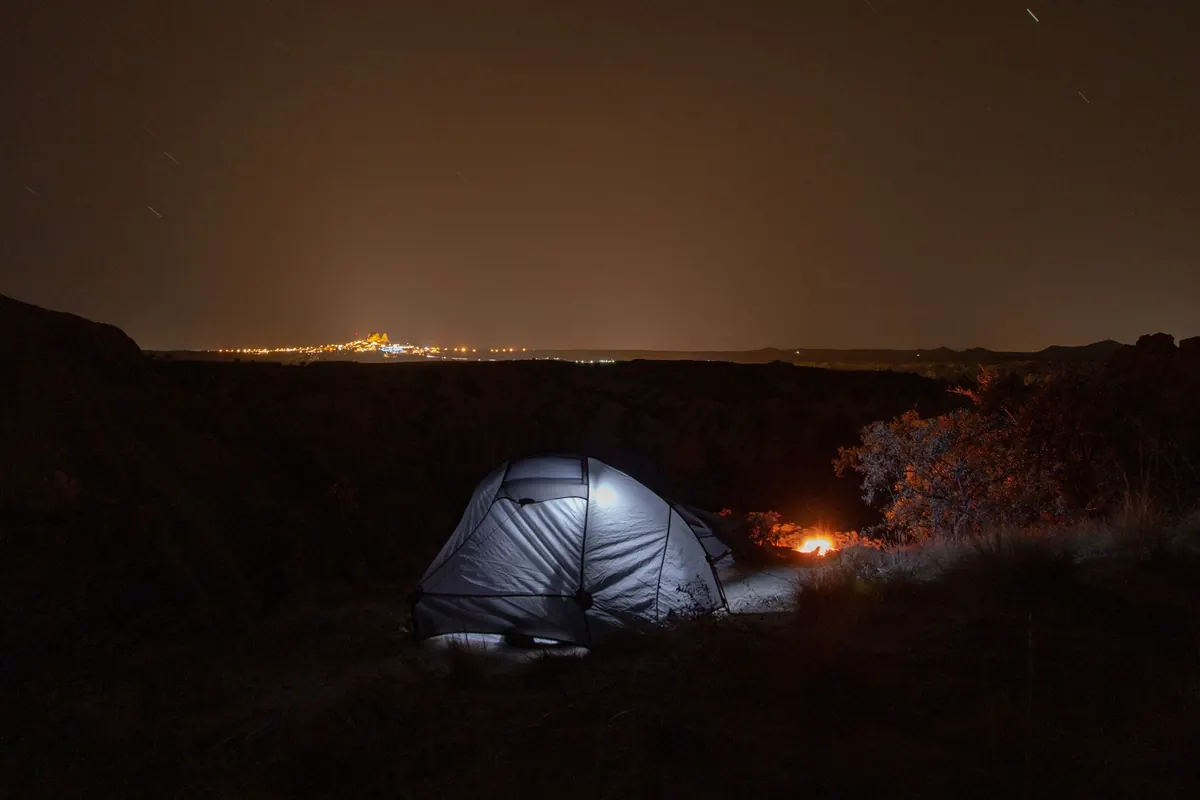
You roll into camp later than planned. The tent still needs pitching, dinner needs cooking, and the last of the daylight is already draining out of the trees. You reach for a light and realize the real question isn't which one is brighter. It's which one lets you get things done.
Headlamps and flashlights overlap more than most gear arguments admit. Both use LEDs, both run on the same batteries, and both will get you to the outhouse. The difference shows up in how you hold them, how long they run, and how much space they steal from your pack. Think through those three things and the choice stops being a debate.
Hands-Free Beats Bright Almost Every Time
The single biggest advantage of a headlamp has nothing to do with lumens: it's that your hands stay empty. Try hanging a food bag, adjusting a tarp line, or lighting a stove with a flashlight in one hand and a lighter in the other. You end up clamping the light in your teeth, wedging it under an arm, or propping it on a rock at exactly the wrong angle.
A headlamp on your forehead aims wherever you look. Cook dinner, filter water, dig for the spatula at the bottom of the bin — the beam follows along without a thought.
Around camp
Setup and takedown in the dark is where a headlamp earns its place. You're tying knots, threading poles, zipping and unzipping, and doing all of it with both hands. A floody beam set at a moderate level gives you a wide pool of light and fewer shadows to squint through.
Inside the tent
Headlamps are fine for reading or sorting clothes in a sleeping bag, but be considerate. A bright beam on someone's face at 6 a.m. is a rude way to wake a tentmate. Use the lowest setting or the red mode, and aim your face down. Some campers prefer a small rechargeable lantern hanging from the loop at the top of the tent for this reason alone.
The brightest light you own is useless if it is stuck in the hand you need for something else.
Brightness and Beam Shape Matter More Than the Lumen Number
Lumens measure total output, not usefulness. A wide, even beam at 150 lumens often beats a narrow, harsh beam at 500 for cooking and camp chores, because you're lighting a space rather than a point. For walking a trail at a normal pace, somewhere in the 100 to 300 lumen range is plenty; go higher only if you're moving fast, biking, or scanning far ahead.
Flashlights generally throw light farther and in a tighter beam. That's why they're better for checking a noise down the shoreline, looking for a trail marker across a meadow, or walking a road shoulder where you want to be seen by drivers. Many headlamps split the difference with two emitters — a flood for camp and a spot for the trail — and a red mode that preserves your night vision when you only need to find the water bottle.
Battery Life, Cold Weather, and Recharging
Battery life depends almost entirely on the brightness setting, not the format. On high, most lights give you a few hours. On low, the same light can run for dozens. Read the runtime figures with that in mind and plan for the setting you'll actually use.
Cold nights drain batteries faster, especially disposable alkalines. A few habits keep you out of the dark:
- Carry a spare set of batteries sized to your light, and keep them in an inside pocket rather than a pack lid.
- For winter trips, lithium or quality rechargeable batteries hold up better in freezing temperatures than standard alkalines.
- Use the lockout or electronic lock feature if your light has one, so it doesn't switch on inside your pack and arrive dead.
- Charge power banks and rechargeable lights before you leave, and top them up again at the car if you're base camping.
- Store lights with the batteries removed or the contacts taped if you won't use them for months. Leaking alkalines ruin more lights than drops do.
Packability and Durability
A headlamp is the winner on weight and volume. Most are small enough to disappear in a hip belt pocket or the top of a stuff sack, and the strap means there's nothing to misplace in the dark. Weight typically lands in the range of a couple of ounces, which is hard to argue with.
Flashlights are heavier and bulkier for the same output, but they have fewer parts to fail. An elastic headband eventually stretches, and a plastic buckle can crack. A simple cylindrical flashlight has one switch and one body. That said, a flashlight switch is easier to bump on inside a pack, and a full-size model is a genuine lump on a long hike.
Look for a splash or water resistance rating on either type. Camping in rain or setting a light down in wet grass is normal, and a light that quits after a drizzle is a nuisance. A wrist lanyard on a flashlight is a small feature you'll appreciate the first time you fumble it over a creek.
When a Flashlight Is the Better Call
Headlamps aren't always the answer. Reach for a flashlight when you need to:
- Throw a beam a long distance — scanning a trail junction or checking what's rustling near the bear hang.
- Light up a wide area from a raised angle, like the underside of a car hood or a tarp ridge.
- Hand a light to someone else without also handing over your hat.
- Keep a simple backup that lives in your pack permanently and never gets borrowed.
- Give a kid something to hold that feels less like a headband and more like an adventure tool.
Car campers, in particular, get a lot out of a larger flashlight with a magnetic tail cap. Stick it to the truck bed or a metal table leg and you've got a work light with no hands involved.
The Setup That Works for Most Campers
Bring both, but give them different jobs. A headlamp is your primary light for camp chores, trail walking, and middle-of-the-night trips out of the tent. A compact flashlight — or a tiny keychain light clipped to your pack — is your backup and your long-throw option. That combination covers nearly everything, weighs very little, and means a dead battery never ends your evening.
If you're buying your first light, start with a headlamp you can stand to wear for hours, then add a small flashlight when budget allows. If you mainly car camp and rarely hike after dark, a modest headlamp plus a sturdy handheld will serve you better than one expensive light trying to do both jobs.
Test everything at home before the trip. Turn it on, cycle through the modes, check that the strap adjusts, and confirm your spare batteries fit. Ten minutes in the living room beats thirty minutes of fumbling in the dark at a campsite you've never seen before.
Photo: Selman Arif Golbasi / Pexels